
My Jane Austen Spring

My first Substack. I normally post to my blog, and will likely cross-post this there, but I thought that since this topic might be of more general interest than what I normally write about over there (pomes pennyeach, w(h)ither the novel, political economy & its discontents—you know, the Big 3), I should therefore try out this here site!
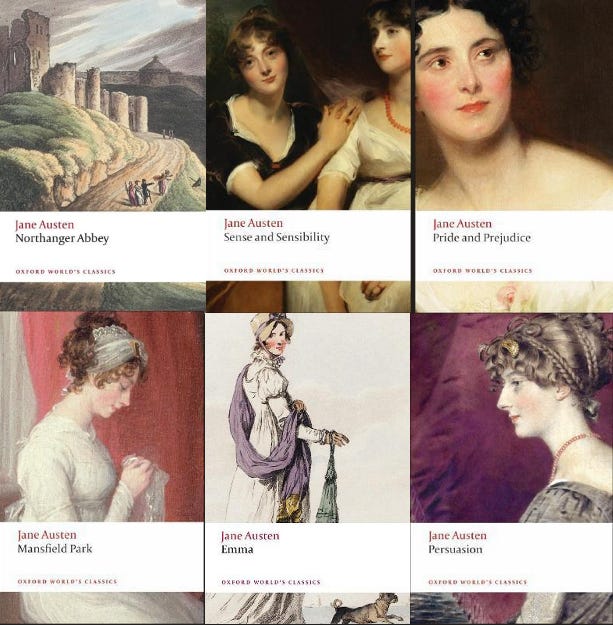
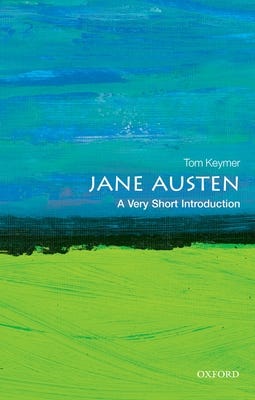
My post-hoc reflection on the novels (which I read in—OK, all but one, see below—chronological order, as I shall write about them here) was stimulated by subsequently reading the (absolutely superb) Oxford Very Short Introduction by Tom Keymer, which I shall body-forth in ‘digested’ form (less a paraphrase, more filtering through one reader’s would-be-‘disinterested’ mind), and from which I shall quote quite liberally for those who might wish to have a gloss on a gloss, or a primer on a primer, to refresh one’s memory, say, or to get a first, tenuous handle on Miss Austen’s world before committing to the novels themselves.
Finally, no AI was employed by me at any time, ever, in the writing of this (or any other) piece. Just can’t stand the stuff, sorry.
To Begin With
I simply cannot imagine a more helpful and well-thought-out and -written an Introduction that’s as Very Short as this. The very epitome of VSI tomes, this is (now try singing that to the tune of ‘the very model of a modern major general’).
What was most surprising to this Austen neophyte was just how outrageously uncorseted (unVictorian avant la lettre?) our teen-aged apprentice writer JA was, writing often rather Tristram Shandyish experimental fictions with which to regale the fam round the hearth-side, fictions which could even border on the…risque!
After her death, her nephew remarked of this lively apprentice period as being marked by ‘juvenile effusions’ which were nevertheless ‘worth noting if only as a specimen of the kind of transitory amusement which Jane was continually supplying to the family party’. As Tom Keymer, the author of this VSI, notes, however,
Effusion the [word is] worth dwelling on. [Effusion] carried a certain prestige in Austen’s day, when Coleridge and Wordsworth, among others, employed it to distinguish particular poems as spontaneous, authentic outflows of creative imagination. High praise was also intended in Northanger Abbey, where Austen hails novels by Frances Burney and Maria Edgeworth, her leading female precursors, as ‘the liveliest effusions of wit and humour…in the best chosen language’ (I.v). In Victorian usage, however, effusion took on a pejorative edge, implying the absence of disciplining intelligence or structuring art.
‘Effusion’ is indeed a bon mot for what one encounters in Northanger Abbey, the novel is very close in both time and spirit to JA’s (reportedly highly successful) attempts in these early fictional outings (i) to amuse herself and family, and (ii) to demonstrate, via satire, what does and does not qualify as ‘real’ ‘literature’:
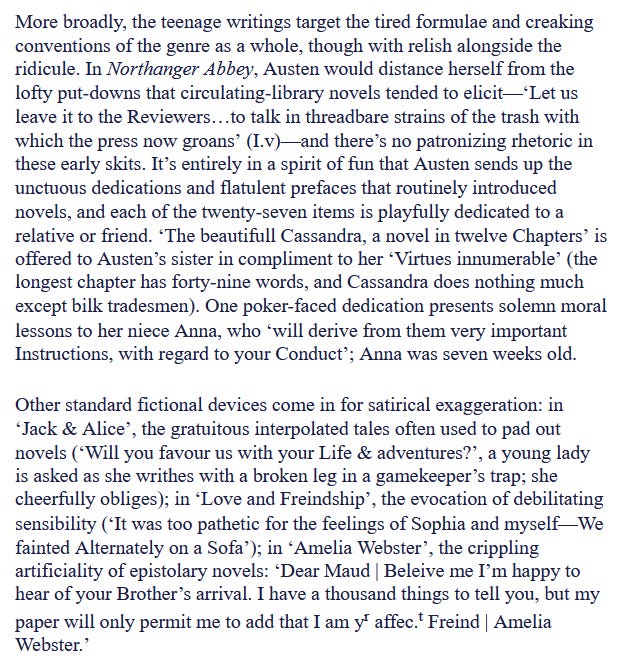
What an anarchic, incredibly imaginative, and witty writer, the young Jane Austen is!
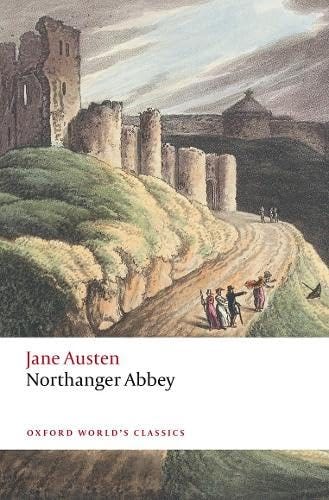
Northanger Abbey
(Or, If On A Regency Night A Reader)
My unlettered take:
5*
Spoiler alert: one of the most (pseudo-) spoily spoilers evah (GOAT?!) incoming:
The anxiety, which in this state of their attachment must be the portion of Henry and Catherine, and of all who loved either, as to its final event, can hardly extend, I fear, to the bosom of my readers, who will see in the tell-tale compression of the pages before them, that we are all hastening together to perfect felicity. (NA)
The narrator/implied author drops this with only a very few pages left indeed, and/but alert: it thrills up and down the spine of any reader who loves to see authors at play with readerly expectations and writerly/generic conventions. Needless to say, I personally had a ball with this, JA’s first completed and most ‘explorative’ novel.
Its escalator pitch: young girl has read too many (or is that just enough?) Gothic novels, and can’t help but seek covert mysteries, romance and adventure wherever she goes, and therefore finds...not quite what those novels have trained her for.
And if it is in Northanger Abbey that Austen discovers that “free indirect discourse” that she will later go on to perfect elsewhere, it is also here where she engages her forerunner authors and contemporary readers both in a friendly game of ‘spot-the-cliché’ and run-with-it, play-with-it, go-all-knowingly-arch-and-allusively-elusive-with-it …. And, despite (?) ironic understatement being JA’s fave trope, this book is up there with Tom Jones and Tristram Shandy in the Most Fun to Be Had in the LC18 (the Long 18th Century, ~1688-1814) Department (so far, for me at least).
Of the Austens I have read so far (The delightful P&P, The fine S&S, 80% of that real-earnest-snorer, MP) by far my favourite, the one which is likely to be re-read by this reader who goes into a gothic swoon whenever writers write of writers writing and readers reading.
P.S. I bought this edition in paper, and as far as scholarly accoutrements go, I’d say it is a wash with the Penguin edition (which I have as an eBook), though I’d give a slight edge to this, the Oxford’s, introduction, which does a very nice job of tying it all together if read (as one surely must!) as an Afterword. There is also an older Oxford Omnibus edition to be had in Used Book Land, which includes Lady Susan, The Watsons and Sanditon...not sure why it went OOP, but Penguin has those in a separate edition, and that’s where my $$ went...
After reading Keymer:
If by the time we get to Mansfield Park and the (for me) tedium of Fanny Price’s and Edmund’s and his father’s moralizing about the ‘unsafe amusements’ of putting on an erotically charged Restoration comedy in the (absent) father’s man cave…
But what about amusement? Here is another word with a double edge, meaning not only to entertain but also, at least potentially, to distract or mislead, like the ‘unsafe amusements’ of amateur theatricals in Mansfield Park (II.ii). In the Memoir, Austen-Leigh quotes an anecdote from his sister Caroline—another fun-loving Regency child turned crusty Victorian—in which Aunt Jane warns her against writing too much while too young, and confesses of her own output ‘that she knew writing stories was a great amusement, and she thought a harmless one, though many people, she was aware, thought otherwise’.
…in Northanger Abbey, at least, such moral strictures do not hamper exuberant authorial exploration: what are the snakes and ladders, the perils and profits, its author asks, of a youth spent in the world of the unreal, in that of the Gothic novel of the 1790s?
By the end of the decade, it was commonplace for magazine critiques with titles like ‘Terrorist Novel Writing’ (1798) to ridicule the Gothic for its tendency ‘to make terror the order of the day, by confining the heroes and heroines in old gloomy castles, full of spectres, apparitions, ghosts, and dead men’s bones’. Yet the bloody horrors and eerie phantasmagoria of these works were not just sensationalist routines. With their daggers and prisons, their bloodshed and phantoms, the best Gothic novels also speak—not as conscious metaphor, but in subliminal ways—to the public atmosphere of turmoil, anxiety, and shock in which they were written and read. For the Marquis de Sade, in a remarkable essay of 1799, the imaginative world of Radcliffe and Lewis ‘was the necessary offspring of the revolutionary upheaval which affected the whole of Europe’.
It verysoon became a verymuch overdone thang, of course, and part of what animates Northanger Abbey is that youthful JA spirit which desires nothing so much as to send up the confused pretensions and hackneyed tropes of popular fiction. Yet it is also a desire to celebrate that fiction as well—and to show what a receptive/susceptible young mind trained in the art of reading such ostensibly unhealthy material can understand and even discover about her world—what her supposedly more wise & sober betters cannot.
She will not, like supercilious book reviewers, turn ‘contemptuous censure’ on pulp fiction (I.v). For while it may be absurd to take Gothic novels literally as a guide to modern life, these novels aren’t necessarily absurd in themselves, and when more thoughtfully approached as metaphors of evil, they may have real explanatory power. After all, the polite world of a modern spa still has its perils and pains, and through clever deployment of Gothic hyperbole in her opening volume—Catherine repeatedly suffers ‘dread’, ‘mortification’, ‘agony’, ‘misery’, ‘torment’—Austen draws quiet [and often ambiguous, ironic] analogies between the trials of [e.g.] an [Anne] Radcliffe heroine and the mundane but no less absorbing tribulations of an ingénue in predatory Bath [...] Her predicament is not literally that of a Gothic novel. Yet Gothic novels can still express and reveal modes of persecution and entrapment that continue to operate, though in new guise, in a world of polite sociability.
Sense and Sensibility
My unlettered take:
3.5* (Superb start and a propos, wish-fulfilling finish...felt like it could use a bit of a corset-ing ‘round the middle...)
The most helpful introduction to this OUP edition (which among other things pointed out how much sheer artistry went into the making of this book) went a long way toward making me appreciate this debut outing more after finishing it, but perhaps reading Pride and Prejudice spoiled me somehow, raising the bar rather unfairly, cos really, compared to most of what came before it (Don’t worry, Mssrs Swift, Fielding, and Sterne, I am casting my cold eye at Defoe and Richardson over there), it’s a downright philosophical crowd-pleaser, albeit one with far fewer moments of crafty, sentence-by-sentence delight which, after P&P, I’d come to expect—ah, that ‘that sanguine expectation of happiness which is happiness itself’!
Otherwise, the chief delights herein came from laughing at and forming judgments about the property/inheritance calculating classes and their machinations to extract maximum utility from same, viz.
an annuity is a very serious business; it comes over and over every year, and there is no getting rid of it. You are not aware of what you are doing. I have known a great deal of the trouble of annuities; for my mother was clogged with the payment of three to old superannuated servants by my father’s will, and it is amazing how disagreeable she found it.
And
Lady Middleton was equally pleased with Mrs. Dashwood. There was a kind of cold hearted selfishness on both sides, which mutually attracted them; and they sympathised with each other in an insipid propriety of demeanour, and a general want of understanding
As for the philosophical bits, most are implicit or alluded to, but the pedagogue still in me thrilled to see, e.g., a humorous bit of repartée between the sexes concerning the c18th ‘picturesque’:
You must not inquire too far, Marianne—remember I have no knowledge in the picturesque, and I shall offend you by my ignorance and want of taste if we come to particulars. I shall call hills steep, which ought to be bold; surfaces strange and uncouth, which ought to be irregular and rugged;\* and distant objects out of sight, which ought only to be indistinct through the soft medium of a hazy atmosphere.\* You must be satisfied with such admiration as I can honestly give. I call it a very fine country—the hills are steep, the woods seem full of fine timber, and the valley looks comfortable and snug—with rich meadows and several neat farm houses scattered here and there. It exactly answers my idea of a fine country, because it unites beauty with utility—and I dare say it is a picturesque one too, because you admire it; I can easily believe it to be full of rocks and promontories, grey moss and brush wood, but these are all lost on me. I know nothing of the picturesque.
I suspect,’ said Elinor, ‘that to avoid one kind of affectation, Edward here falls into another. Because he believes many people pretend to more admiration of the beauties of nature than they really feel, and is disgusted with such pretensions, he affects greater indifference and less discrimination in viewing them himself than he possesses. He is fastidious and will have an affectation of his own.’
‘It is very true,’ said Marianne, ‘that admiration of landscape scenery is become a mere jargon. Every body pretends to feel and tries to describe with the taste and elegance of him who first defined what picturesque beauty was.\* I detest jargon of every kind, and sometimes I have kept my feelings to myself, because I could find no language to describe them in but what was worn and hackneyed out of all sense and meaning.’
I enjoyed this a fair bit…I just didn’t highlight nearly all of it, ha-ha, as I did with P&P—not very much at all, in fact. But one more bit I’ll share, and attempt to live up to the spirit of, that may well resonate with a friend or two hereabouts:
I know the summer will pass happily away. I mean never to be later in rising than six, and from that time till dinner I shall divide every moment between music and reading. I have formed my plan, and am determined to enter on a course of serious study. Our own library is too well known to me, to be resorted to for anything beyond mere amusement. But there are many works well worth reading, at the Park; and there are others of more modern production which I know I can borrow of Colonel Brandon. By reading only six hours a-day, I shall gain in the course of a twelve-month a great deal of instruction which I now feel myself to want.
After reading Keymer:
If in Sense and Sensibility we perceive a reigning-in of the youthful-anarchic (as the sister-with-too-much—18thC—capital-S ‘Sensibility’—too much Rousseau!—learns to love the sensible-with-a-heart older Colonel), eventually, the critics of the day ignored the complexities of what I’ve just summarized and welcomed, rather, the purported, easily digestible, uplifting parable:
The object of the work is to represent the effects on the conduct of life, of discreet quiet good sense on the one hand, and an over-refined and excessive susceptibility on the other. The characters are happily delineated and admirably sustained. Two sisters are placed before the reader, similarly circumstanced in point of education and accomplishments, exposed to similar trials, but the one by a sober exertion of prudence and judgement sustains with fortitude, and overcomes with success, what plunges the other into an abyss of vexation, sorrow, and disappointment. An intimate knowledge of life and of the female character is exemplified in the various personages and incidents which are introduced, and nothing can be more happily portrayed than the picture of the elder brother, who required by his dying father, to assist his mother and sisters, first resolves to give the sisters a thousand pounds a-piece, but after a certain deliberation with himself, and dialogue with his amiable wife, persuades himself that a little fish and game occasionally sent, will fulfil the real intentions of his father, and satisfy every obligation of duty. Not less excellent is the picture of the young lady of over exquisite sensibility, who falls immediately and violently in love with a male coquet, without listening to the judicious expostulations of her sensible sister, and believing it impossible for man to be fickle, false, and treacherous. We will, however, detain our female friends no longer than to assure them, that they may peruse these volumes not only with satisfaction but with real benefit, for they may learn from them, if they please, many sober and salutary maxims for the conduct of life, exemplified in a very pleasing and entertaining narrative. (The British Critic, May 1812)
The attentive reader’s experience of this novel might best be summarized as the polar opposite of the British Critic’, however: For Austen’s chief interest lies in subtly ironizing the titular categories that the two sisters are claimed to portray, to find that ambiguity which lies latent in any overhasty ‘reading’ of self and society. Finishing this novel, we depart as unconvinced that it is an entirely good thing to be a scrupulously ‘sensible’ Elinor as that it is always and ever regrettable that the Mariannes of this world give over to what DEVO called the ‘uncontrollable urge[s]’ of the soul’s passions. We do become attuned, however, to that ongoing, more satiric twinkle in our author’s all-seeing eyes: though she portrays and explores (‘shows’) the realm of the particular much, much more than she ever concludes or demonstrates some abstract principle (‘tells’), in AustenWorld we are never all that far from that quietly comic mock-dictum of Auden’s:
Describe the amorous effect of ‘brass’,
Reveal so frankly and with such sobriety
The economic basis of society.
Pride and Prejudice
My unlettered (second-time-round, eons later) take:
5*
I first encountered (was subjected to) Pride and Prejudice aged 12, in grade 8 ‘reading lab’, where the idea was, after you get to a certain machine-graded comprehension/rapidity quotient of some kind, you were thrown into a smaller room with a different teacher and imbued with ‘the classics’.
Stevenson’s Kidnapped was a lot of fun, but I voted to impeach Thomas Hardy’s Mayor of Casterbridge, and was suitably, erm, quite prejudiced about Pride and Prejudice as any WWII-obsessed 12-year-old boy could, if perhaps shouldn’t, quite, be.
And so I was disinclined, vis-a-vis any subsequent re-attempt thereof, until multiple re-readings of Martin Amis’s criticism convinSo, ced me to set such pre- or rather callow judgement aside, for MA was quite the fan of her work and of P&P in particular—and I was a mega-fan of his, so….
So, Miss Austen & I got along a lot better than we did back in that Grade 8 Reading Lab…This, from the Oxford edition's Introduction, might prove useful for those wondering about their own relationship to loving P&P, or books in general, or love:
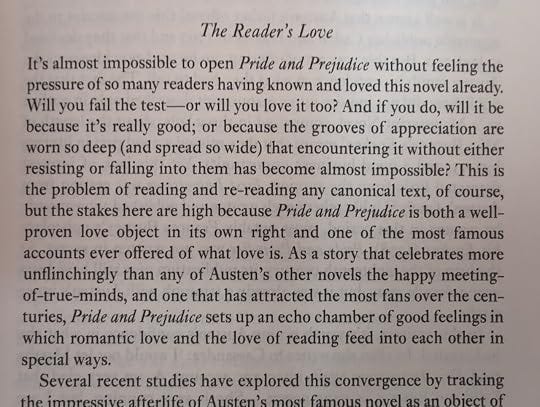
I don’t have all that much else to add to that, save the following passage, which to me is a kind of a proleptic comment upon the very idea of blogging about Jane Austen in such an unscholarly way as I am doing, and yet ‘in public’, for attention:
..she gave a great yawn and said, ‘How pleasant it is to spend an evening in this way! I declare after all there is no enjoyment like reading! How much sooner one tires of any thing than of a book—When I have a house of my own, I shall be miserable if I have not an excellent library.’
No one made any reply. She then yawned again, threw aside her book, and cast her eyes round the room in quest of some amusement”
After reading Keymer:
Describe the amorous effect of ‘brass’,
Reveal so frankly and with such sobriety
The economic basis of society.
If we keep those words of Auden’s in mind when we encounter that (justly) celebrated opener of Pride and Prejudice, viz…
‘It is a truth universally acknowledged, that a single man in possession of a good fortune, must be in want of a wife’ (emphasis added)
…then we must somewhat deprecate or at least smile at the ineluctability of the momentum in that narratorial steamroller, that ostensible ‘must’. This narrator (with JA, not always to be confused with ‘this author’) demands, no, simply assumes, that it is impossible for us to disagree on such a matter as what (such an—ka-ching, ka-ching—eligible) a bachelor most ‘wants’ (needs, not desires in the 18thC)’, for she has just ushered us—shushing us, but motioning to keep our wit(s) about us, our eyes on the prize—with her into drawing rooms of her class…
In ways made inescapable as the novel unfolds, her statement suggests not reliable authorial truth-telling—the wise, moralizing commentary that guides readers through George Eliot’s Middlemarch, say—but satirical invocation of a communal voice. It conjures up the shared perspective of genteel home-counties society—‘the minds of the surrounding families’ (I.i)—and mimics the thought and language of this society: diminished thought and impoverished language, in which the petty, self-interested assumptions of Mrs Bennet and her neighbours are casually dignified into something more. A masterstroke of comic bathos and teasing plot anticipation, the trick also foreshadows the clever intricacies, strategic uncertainties, and subtle, agile ventriloquisms of the narrative ahead.
This brings us to ‘Free Indirect Discourse’, the famous hallmark of Austen’s fiction (first to perfect if not outright invent), that ‘illusion by which third-person narrative comes to express, as though infiltrated by, or emanating from, the intimate subjectivity of fictional characters’. It is ubiquitous in the later novels, but present in all of them (perhaps because of late revision), and with Pride and prejudice it begins to permeate, often satirically, her text:
[…] in Austen’s hands the effect of free indirect thought is typically one of blending and blurring, not clear-cut counterpoint. By merging a character’s idiolect with a narrator’s syntax, by darting from viewpoint to viewpoint in adjacent sentences, and by studding passages of objective description with clause-length shards of free indirect discourse, Austen endlessly problematizes the origin and authority of her narrative statements. At the same time, she creates a remarkable narrative impression of conversational fluidity, often using rhythmic as opposed to strict grammatical punctuation to suggest the contours of consciousness in action or the informality of a speaking voice. Sometimes we sense a harmonious alignment of perspective between character and narrator, at others a more disruptive effect of irony or uncertainty. With this signature technique of her fiction, Austen calls on readers to navigate her prose with vigilance and discernment, and in a spirit that recognizes a lesson she would take further in Emma: that ‘seldom, very seldom, does complete truth belong to any human disclosure’ (III.xiii)
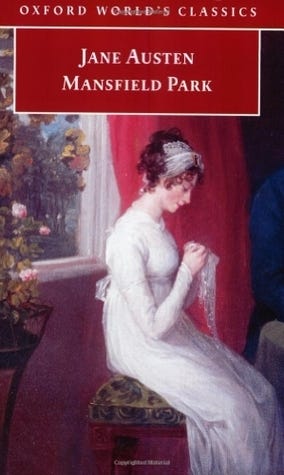
Mansfield Park
My unlettered take:
2.5* (OK: 3)
Lady Bertram did not think deeply, but, guided by Sir Thomas, she thought justly on all important points; and she saw, therefore, in all its enormity***, what had happened, and neither endeavoured herself, nor required Fanny to advise her, to think little of guilt and infamy [emphasis added].
My least favourite JA so far...Now a “mature” writer, Miss Austen seems to have jettisoned the anarchic tendencies of the juvenilia (still enlivening the prose of the trio of novels composed before the turn of the century—Northanger Abbey, Sense & Sensibility, and Pride & Prejudice)... in favour of a “less entertaining” (her words) moral seriousness...
And I s’pose I can “appreciate” the tour-de-force-ness of its undertaking (her patent-pending technique of “free indirect style” is further perfected/ratcheted-up, as well), if not quite revel in the length said tour goes to hammer certain ethically normative propositions home, viz. how to avoid the manifold enormitiesthat life-in-mammon affords both the naive and unscrupulous among us, via a certain, constant inward vigil or watchfulness by what Freud might call the Censor, lest one’s impulses ever be acted upon, i.e. be allowed to run riot over one’s firmly-held (corseted?!) commitments, viz.
Moral/-ly/-ity 16 instances
Earnest/-ly/-ness: 27 instances
(etc. Fuller list below)
***From The King’s English, by Kingley Amis:
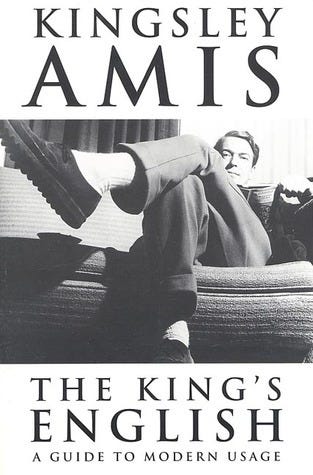
Enormity, enormous
Centuries ago these two words must already have begun to drift apart and now are as separate as their respective meanings, viz. great wickedness (noun) and very large (adjective). When Milton wrote of Nature in Paradise pouring forth ‘enormous bliss’ he was making a learned pun, giving a reminder of the Latin roots (ex- or e- = out of, norma = norm, the ordinary) while testifying to the sheer size or quantity of the bliss. But when Eliot (T. S.) wrote of ‘the enormity of man’s ignorance’ he was just getting it wrong: by rights he should have written enormousness. A fine example of English style he was, with his ‘juvescence of the year’ when he should probably have written juvenescence, though that might have been wrong too for his purposes.
Such hiccups aside, however, enormity and enormous continue on their way and are quite safe to use while they keep their stations as outlined above.
After reading Keymer
Before we get to the spritely Emma, however, we must trudge through the sternly manicured Mansfield Park, so clerically-obsessed and ‘serious of theme’…
E.g., above, I began what Professor Moretti calls a ‘distant reading’ of the book, enumerating some rather telling vocabulary predilections…
Moral/-ly/-ity 16 instances
Earnest/-ly/-ness: 27 instances
Justly/Justice: 26 instances
Respectable/-bility 22 instances
Delicacy: 25 instances
Honour/-able: 36 instances
Proper: 26 instances
Propriety: 22 instances
Properly: 22 instances
Property: 22 instances
…Austen herself anticipated that her fans would have a hard time coming from Pride and prejudice to this (in her own words) ‘“not half so entertaining”’ novel with its morally scrupulous tone and its tone-embodying heroine, Fanny price, ‘“whom no one but myself will much like’”.
It’s sometimes argued that when Austen talked about ‘Ordination’ as the novel’s theme, she used the word in a broad sense of ordering or rectifying—setting in order, setting to rights—that went beyond its technical meaning in the Anglican Church. More broadly, ‘Ordination’ encompasses the whole dynamic of the novel, with its disordered individuals, families, and estates; Mansfield Park thus becomes a novel about reforming a host of moral, spiritual, and social dislocations, with Edmund—the ethically serious, professionally committed clergyman in waiting—as the key agent of change […] [in] an environment freighted by Austen with a symbolism of boundaries and transgressions—fences, palisades, gates, ha-has—in the zone between unregulated wilderness and cultivated park.
All to the greater good, such cultivation, I’m sure, but I can’t help but think that the young Jane Austen would find it all not much fun….
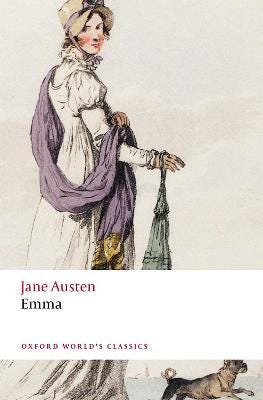
Emma
My unlettered take:
4*
Again, more admired than (as with Northanger and P&P) truly loved, but Miss A. has still got the acerbic chops, viz.
In this age of literature, such collections [of romantic riddles] on a very grand scale are not uncommon…
And:
Human nature is so well disposed towards those who are in interesting situations, that a young person, who either marries or dies, is sure of being kindly spoken of.
And:
…a sanguine temper, though for ever expecting more good than occurs, does not always pay for its hopes by any proportionate depression. It soon flies over the present failure, and begins to hope again.
And:
I do not know whether it ought to be so, but certainly silly things do cease to be silly if they are done by sensible people in an impudent way.
Etc.!
And I totally get how JA is taking the nation’s temperature here, just after the Napoleonic wars, and finding, erm, some rather overheated social mobility on the part of the more…grasping classes, so there is much to ironically understate about in these pages, and it is all carried off without a hitch (whatever that is): risible characters be shown to lack riz, &c. Great stuff. Do not need to be persuaded to go on to Persuasion.
After reading Keymer
After (the arid high plains of) Mansfield Park, it is with some relief that we welcome the return, however much part way, of Austen’s satiric mode in Emma, a novel which among other themes explores the import and impact of social rank upon English society and soul:
Austen famously wrote that for a novelist, ‘3 or 4 Families in a Country Village is the very thing to work on’ (9 September 1814). […] Centrally important throughout Austen’s fiction are the structures, dynamics, and consequences of rank (a more useful term than ‘class’, with its Marxian baggage, for the intricate hierarchies of status and privilege at play in all the novels). It’s in Emma that Austen unfolds the system in its finest and supplest calibrations, and she does so by refracting her narrative through the mind of a heroine firmly committed—unlike the more socially disruptive protagonists of other novels—to monitoring boundaries and keeping everyone in their place. She has a job on her hands, for Emma also registers the energies of social mobility in Regency England, but Austen’s emphasis falls above all on the starting positions. With its distinct yet interconnected ‘sets of people’—the phrase recurs in Persuasion and ‘Sanditon’, and in Emma accommodates ‘the chosen and the best’, the ‘second set’, and more (I.iii)—Highbury society connects, while also compartmentalizing, a broadly representative spectrum of genteel and middling-sort life.
[…]
Tellingly, Emma herself recoils from […] indecorous contacts. She has no time for Knightley’s unsettling idea, in Martin’s case, of locating ‘true gentility’ in practical merit as opposed to technical rank (I.viii). She’ll mingle with the well-born and minister to the poor, but ‘the yeomanry’—rural freeholders, respectable farmers, and the like, too high for her charity, too low for her notice—‘are precisely the order of people with whom I feel I can have nothing to do’. They’re ‘another set of beings’, alien to her mind, though in fact playing a crucial role in making the world of Highbury cohere and thrive (I.iv). Throughout the novel, this anxious correctness of form identifies Emma’s elite status as discernibly less secure than her future husband’s. Where Knightleys have owned land and lived from its yield since the dissolution of the monasteries (the name Donwell Abbey, like Northanger, is a reminder of ancient confiscation), the Woodhouses are relative newcomers to their ‘notch’ in the Donwell estate, and they live primarily from investments.
[…]
When Elton marries money of uncertain provenance, his new wife—the absurdly named Augusta, with her even more risible sister Selina—is in Emma’s eyes ‘a little upstart, vulgar being’ (II.xiv). But Mrs Elton expresses her own ‘horror of upstarts’ (II.xviii), and so the chain of upward aspiration and downward exclusion goes on. All subscribe to the hierarchy of rank in general while seeking to breach it in person.
The upshot is that we readers delight in both sharing in and critiquing and above all laughing at Emma’s and her circle’s foibles and (sometimes hidden, always in need of reform!) vices and even virtues, as we also reflect upon our not-so-different own. In my opinion, the manifestly contradictory Emma Woodhouse is simply a much more fertile invention for exploring our inherent ambiguities than is the uniformly upstanding Fanny Price (/rant).
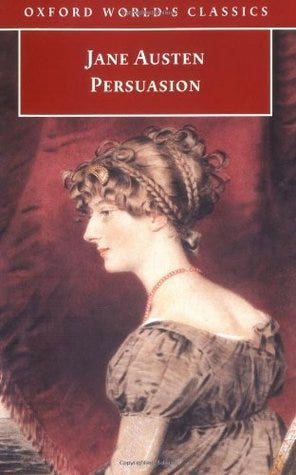
Persuasion
My unlettered take
4*
Before she plunges into a fascinating spree of speculations as to how, had Jane Austen survived to compose “the six novels that [she] did not write,” JA would have proceeded on along her “voyage of discovery” to become the “forerunner of Henry James and of Proust,” Virginia Woolf has this*** to say about JA’s final novel, Persuasion, completed in 1816, scant months before she died in July of 1817:
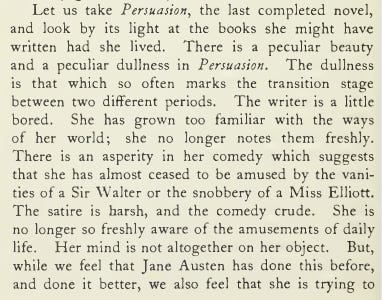
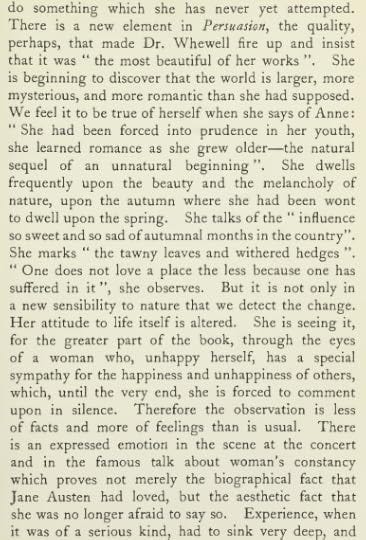
There is very little here that I should like to quibble with. Rather, when I return to this book (and I do hope I shall), I’ll surely mull over my previous highlights as I also add to them in wonder at how much I missed in my initial encounter with Anne Elliot: For while it may not yet be my favourite of JA’s novels, Persuasion is certainly not a book that “discloses all” to a mere first reading.
After reading Keymer:
Finally, we come to Persuasion and, for our author Tom Keymer, Austen’s addressing what some of her followers alleged was an aporia in (at least her previous) work: Passion.
For Charlotte Brontë, author of the emotionally expressive Jane Eyre (1847), Austen was unequalled in ‘delineating the surface of the lives of genteel English people’, but the passions were ‘perfectly unknown to her’. She kept even the feelings at a cool distance. ‘Her business is not half so much with the human heart as with the human eyes, mouth, hands and feet’, Brontë wrote: ‘what sees keenly, speaks aptly, moves flexibly, it suits her to study, but what throbs fast and full, though hidden, what the blood rushes through, what is the unseen seat of Life and the sentient target of death—this Miss Austen ignores.’ Note that last twist of the knife: Miss Austen.
The same objection was made by American readers who associated the Austenolatry of their compatriots with a culturally suffocating Anglophilia: readers like Ralph Waldo Emerson (‘Never was life so pinched and narrow’) and Ezra Pound (‘A book about a dull, stupid, hemmed-in sort of life, by a person who has lived it’). Yet a powerful counter-argument also emerged, made by readers more willing to consider implication, and for whom Austen’s most important effects were achieved obliquely. For Henry James, a pioneer of psychological realism in modern fiction, her heroines amounted instead to feeling in its purest form: ‘a sort of simple undistracted concentrated feeling’. They did so in a mode, however, that required readers to probe below the polished surface of Austen’s prose. The effect was most pronounced in the later works, for ‘in of course an infinitely less explicit way, Emma Woodhouse and Anne Eliot [sic] give us as great an impression of “passion”…as the ladies of Sand and Balzac’. The passion was no less intense for being subterranean, for ‘their small gentility and front parlour existence doesn’t suppress it, but only modifies the outward form of it’
So, yet again, to really get or at least grapple with this (or any other) Austen novel, we must acknowledge that to fully Austen, we must first resist the apparent easy flow or light surface tension of the prose, for here especially it is really ‘nervy and jagged’, ‘restless[ly] agitat[ed]’, ‘informal, even expressionist’when examined slowly and carefully.
As Deidre Lynch observes, the technical brilliance of Persuasion lies partly in the sense it conveys of being, not ‘the typical “Austen novel”’, but instead the sequel to such a thing: a novel we don’t have in direct form, but one we’re constantly reminded about, and prompted to reconstruct in our minds through a process of back-formation. Emotionally, intellectually, and simply in terms of her age, Anne Elliot is Austen’s most mature heroine: a 27-year-old who has already lost her ‘bloom’ and ‘glow’ (key terms in the period’s lexicon of sex appeal) in the wake of events that recall the Harriet Smith subplot in Emma. She doesn’t, like Austen’s earlier, younger heroines, enter afresh on the world of courtship. Instead, left on the shelf as the narrative opens, she plays ruefully out in her mind her self-denying refusal, years earlier, of the man she loved and continues to love. […] Persuasion thus unfolds for the heroine as a clever but relentlessly painful reversal of the standard narrative trajectory of courtship fiction: ‘She had been forced into prudence in her youth, she learned romance as she grew older’ (I.iv).
Finally, and to close the circle on my piece, this fine little book, and my first forway into AustenWorld together, in 1816 Austen both finished Persuasion as well as regained her manuscript to ‘Susan’, the forerunner of her ‘first’ novelNorthanger Abbey—both published posthumously. In both works, we find a love of books, especially of novels, propelling the protagonists and ourselves, readers of readers reading, a questioning of, certainly, but above all a celebration of
the capacity of imaginative literature to equip or disable its most ardent readers for life in the real world. Here Austen intriguingly reverses the standard assumptions of her culture about gender and reading. Northanger Abbey was already unconventional in presenting a heroine whose immersion in Gothic fiction, though leading her to misjudge surface appearances, also helps her intuit the presence of something like Gothic oppression in modern guise: bullying John Thorpe; dowry-hunting General Tilney; the coercive social codes exploited by both. At first sight a familiar satire on female reading, the work is in fact more exploratory and double-edged. With grieving, self-absorbed Captain Benwick, however, Austen now presents a male reader whose obsession with the high Romanticism of Scott’s poetry, and Byron’s ‘impassioned descriptions of hopeless agony’ (I.xi), is almost entirely debilitating. By all the standard conventions of satires on reading, weepy broken-hearted Benwick should be a woman. Instead, he’s a naval hero. In one of Austen’s most exquisite touches, he’s in fact the former lieutenant of the warship Laconia, a name connoting Spartan fortitude and resolve.
The irony is further enhanced when we read Benwick’s conversation with Anne, who urges that ‘it was the misfortune of poetry, to be seldom safely enjoyed by those who enjoyed it completely’, alongside mirror episodes in Northanger Abbey. To discipline and contain Benwick’s impassioned despair, Anne recommends exactly the kind of rational, moralizing, essayistic prose that Austen’s narrator critiques in Northanger Abbey (I.v). Yet Anne makes this recommendation while also uneasily recognizing the resistance of her own deep passions to rational supervision.
I, too, shall take Anne’s advice, but only to a point. I say that if we close her final novel in a state of some melancholy, unlike with Captain Benwicklet us rather return to such books as we find in AustenWorld still more fervently, for, with Walter Benjamin, it is not that they come alive in us, but we who may yet live in them.
This is a delight. Makes me want to return to/ discover Austen.
I had a Jane Austen period a few decades ago. I remember it fondly. Looking forward to reading this.